


Agricultural news, Home, News
Comparison of Ri6 and Monthong durians – Characteristics of the two popular durian varieties
Durian Ri6 and Monthong are two popular and highly favored durian varieties due to their delicious flavor, golden flesh, and seedless nature. Although they share many similarities, each variety has distinct characteristics regarding origin, shape, flesh color, flavor, texture (dryness of the flesh), harvest time, yield, cultivation ability, market demand, and selling price. Below is a detailed comparison of durian Ri6 and durian Monthong based on these criteria, helping readers understand the advantages and disadvantages of each variety.
Origin
- Durian Ri6: Originally from Cambodia, it was introduced and successfully trialed in Vietnam by Mr. Sáu Ri (real name Nguyễn Minh Châu) in Long Hồ, Vĩnh Long in the 1990s. From that initial tree, the Ri6 variety has been widely propagated throughout the western provinces such as Cái Mơn (Bến Tre), and has now become a popular domestic durian variety in Vietnam.
- Durian Monthong: This is a famous durian variety originating from Thailand (the name “Monthong” in Thai means “precious gold”). This variety was introduced to Vietnam in the 1990s and is also known as Thai durian or Dona durian. Currently, Monthong is mainly grown in the Mekong Delta and Southeast regions – areas with suitable tropical climates, and is also imported directly from Thailand to meet consumer demand.
Shape and Size of the Fruit
- Durian Ri6: The shape of the Ri6 fruit is slightly elongated and oval, but the bottom of the fruit is narrower (the fruit resembles a diamond shape). The fruit is usually round, quite large, with an average weight of about 3–5 kg/fruit. The skin of the Ri6 durian is bright green, quite thin, and has large, thick but sparse thorns (the density of thorns is not too dense). The stem of the Ri6 fruit is thick and sturdy, helping to hold the heavy fruit. Overall, the Ri6 fruit appears quite round and even, with distinct segments and not overly sharp thorns, helping to distinguish it from Monthong.
- Durian Monthong: The Monthong fruit has an elongated oval shape like an egg, slightly square or can be a bit “flattened” compared to Ri6. The top of the fruit is usually slightly pointed. The thorns of Monthong durian are large and sparse, with a distance between the thorns of about 1.25 cm creating a characteristic sparse thorn surface. The stem of the fruit is about 5–8 cm long, smaller than the Ri6 stem. The skin of the Monthong fruit is green when unripe and may turn yellow when ripe. The average weight is about 2–4 kg/fruit – usually slightly smaller than Ri6. In general, Monthong has a long shape and sparse thorns, helping buyers distinguish it from the Ri6 fruit (which is round and plump with thicker thorns on the surface).
Flesh Color
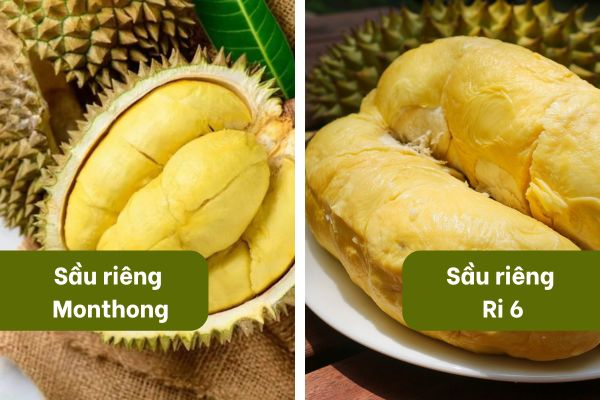
A comparison image of Monthong durian segments (left) and Ri6 (right) shows the difference in flesh color. Durian Ri6 is famous for its deep yellow flesh that is very distinctive and eye-catching. When cutting open a Ri6 fruit, the segments shine with an impressive golden color, creating an appealing sensation.
In contrast, durian Monthong has a lighter yellow flesh, not as rich as Ri6. Monthong segments often have a soft cream yellow color, less vibrant in tone. Although the flesh color is lighter, Monthong segments are usually very large, thick, and juicy. The difference in color is quite clear when placing the two varieties side by side: Ri6 is dark yellow, Monthong is light yellow. The flesh color somewhat reflects the richness of the flavor inside: the dark yellow flesh of Ri6 is often associated with a richer sweetness, while the light yellow of Monthong indicates a lighter sweetness.
Flavor (Aroma and Sweetness)
- Durian Ri6: In terms of aroma, Ri6 has a very strong and distinctive scent. When ripe, the aroma of Ri6 durian is more intense and pungent than many other varieties. This satisfies those who enjoy a “strong” durian smell. In terms of taste, the flesh of Ri6 is thick, seedless, giving a rich sweetness, accompanied by a slight bitter aftertaste that is very characteristic (many durian enthusiasts quite like this slight bitterness at the end) and moderate creaminess. The overall flavor of Ri6 is quite powerful: fragrant, sweet, and moderately rich, leaving a strong aftertaste after tasting.
- Durian Monthong: The aroma of Monthong is lighter and more delicate compared to Ri6 – not too pungent but subtly fragrant and alluring. When opening a Monthong fruit, the aroma spreads gently, “pleasant” even for those who cannot handle the strong smell of durian. In terms of sweetness, Monthong has a light sweetness and is less intense than Ri6, while almost having no bitter aftertaste. Therefore, for those who do not like the slight bitterness of durian, Monthong is the perfect choicew. The creaminess of Monthong flesh is at a moderate level, not too rich; eating a lot does not feel greasy. In general, the flavor of Monthong is easier to eat for the majority – light sweetness, light creaminess, and subtle fragrance – while Ri6 leans towards a richer flavor for more “sophisticated” palates.
Texture of the Flesh and Creaminess (Flesh Structure)
- Durian Ri6: The “texture” here refers to the dryness level, whether the flesh is sticky or not. The flesh of Ri6 durian is famous for being thick and dry, not watery. When peeling a Ri6 segment, the flesh does not stick too much to the hands or skin, indicating that the flesh is dry and firm. In fact, a Ri6 segment held in hand does not stick to the hand much because the flesh is moderately dense. This texture makes Ri6 very enjoyable to eat, with plenty of smooth flesh but not mushy. In terms of creaminess, the flavor of Ri6 is moderately rich, not too oily. Biting into a piece of Ri6 flesh will feel a light creamy richness spreading, blending with the rich sweetness. Thanks to the thick flesh and low moisture, Ri6 also has less fiber, making it smooth to eat.
- Durian Monthong: The flesh of Monthong is also very thick, but the texture is somewhat softer and “moist” compared to Ri6 (Ri6 flesh is drier). The ripe Monthong segments have a moderate softness, and when held, they may stick slightly to the hand due to the soft and creamy flesh. However, one advantage of Monthong is that the flesh is quite thick and can be stored for a long time after harvest while maintaining almost intact flavor – indicating that the flesh is firm enough, not quickly mushy. In terms of creaminess, Monthong is moderately rich, not overly rich. When eating Monthong flesh, one feels the light creaminess melting on the tip of the tongue rather than leaving an oily residue. In general, Monthong gives a smooth and easy-to-eat sensation, while Ri6 gives a firm and rich sensation. Depending on individual taste: those who prefer very dry and rich durian flesh will lean towards Ri6, while those who prefer soft, fragrant flesh with a light creamy flavor will choose Monthong.
Harvest Time and Season
- Durian Ri6: This variety ripens earlier, with a time from flowering to harvest of about 105–115 days depending on care conditions. This means that after pollination, it takes about ~3.5–4 months for the Ri6 fruit to ripen on the tree. Thanks to the shorter growth period, Ri6 is usually harvested earlier than Monthong. In southern Vietnam, the main harvest season for Ri6 falls around the beginning of the rainy season (May–June). When ripe, the fruit skin turns slightly yellowish green, the thorns open slightly, and it emits a fragrant smell, indicating it can be cut down. The early ripening of Ri6 helps farmers earn income sooner, but it is also important to harvest at the right ripeness (not too early or too late) to ensure the quality of the flesh.
- Durian Monthong: Belonging to the late-ripening group, the time from fruit setting to harvest is about 125–135 days – longer than Ri6 by about 15–20 days (which is about nearly 1 month longer). Therefore, Monthong usually enters the harvest season later. In the growing regions in Vietnam, the harvest season for Monthong usually follows Ri6, around July–August (even extending to September in some places). The longer fruit-growing time means farmers have to care for the fruit longer before harvesting. However, if off-season flowering techniques are applied, growers can stagger the harvest. In general, compared to Ri6, Monthong is harvested about 1 month later, suitable for supplementing supply when Ri6 has finished its season.
Yield and Production
- Durian Ri6: The Ri6 variety is highly regarded for its stable yield and early fruiting. Grafted trees can start bearing fruit from the 4th–5th year after planting. When mature (about 8–10 years old), each Ri6 tree can produce an average of 60–80 fruits per year, equivalent to about 20–30 tons/ha (under good intensive cultivation conditions). In fact, the production of Ri6 durian in Vietnam is very large. According to the Ministry of Agriculture and Rural Development, the total production of Ri6 domestically from 2020 to 2022 reached about 100,000–120,000 tons/year, accounting for a high proportion of the domestic durian market. This shows that Ri6 is a key variety, producing a lot and consistently over the years if cared for correctly. High yield combined with good selling price helps Ri6 bring significant income to farmers.
- Durian Monthong: In terms of potential, Monthong is also a variety that yields high, even each tree can produce many large fruits. However, due to more difficulties in fruit setting, the actual yield depends heavily on the technical experience of the farmers. With well-cultivated orchards, the yield of Monthong is not inferior to Ri6, reaching ~20–25 tons/ha (equivalent to Ri6) or more. In Vietnam, Monthong mainly comes from imported sources from Thailand and partly from domestic orchards. The imported yield of Monthong from 2020 to 2022 was about 50,000–70,000 tons/year – about half lower than domestic Ri6. This discrepancy is partly due to the area planted with Monthong domestically not being as large as Ri6, and imports being subject to quotas. Nevertheless, the trend of planting Monthong is increasing thanks to this variety having thick golden flesh, sweet and creamy flavor that is easy to eat and is favored by the market, especially in exports. The yield of Monthong, if properly invested, is still very promising, and when combined with the amount imported from Thailand, this variety contributes to stabilizing the supply of durian for the market.
Cultivation Ability and Adaptability
- Durian Ri6: In terms of cultivation, Ri6 is considered easy to grow and care for. This variety adapts well to many soil types (alluvial soil, red soil, well-drained clay soil…) and withstands the hot and humid climate of the South and Central Highlands. The Ri6 tree grows vigorously and easily flowers and fruits, with a high fruit set rate even for novice gardeners. Many farmers comment that Ri6 is “easy-going”: just ensure proper irrigation and fertilization, and the tree will develop well and bear fruit regularly every year. The time to bear fruit is also earlier – around the 4th–5th year, there is already a harvest. Especially, for new planters, choosing Ri6 will have less risk because the tree requires less complex techniques in flowering management. In less than ideal soil and climate conditions, Ri6 can still yield quite well. In general, Ri6 is suitable for large-scale commercial cultivation in many regions, being a “billion-dollar crop” that provides stable income for farmers.
- Durian Monthong: Although the Monthong variety grows very vigorously (the tree grows quickly, with a wide canopy) and has a high adaptability to tropical climates, it requires higher cultivation techniques. The Monthong tree is more difficult to manage flowering and fruit setting compared to Ri6. Growers need to have experience in water management, flower bud treatment, supplemental pollination… to achieve good fruit set rates. This is a challenge for novice farmers. Furthermore, the fruit-growing time is longer (as mentioned, ripening about ~1 month later), so disease management and nutrition need to be extended – just one mistake can affect yield. However, despite the high technical requirements, Monthong has high economic value in the export market. This variety is chosen by many large growers because the fruit has thick skin, is less damaged during long-distance transport, and is favored by foreign customers. In Vietnam, Monthong is suitable for cultivation in tropical regions such as the Central Highlands, Southeast, and Mekong Delta similar to Ri6 (the North is too cold to grow durian). In summary, Monthong is suitable for experienced growers aiming for export, while Ri6 is suitable for mass cultivation and new growers due to its easier care.
Market Consumption
- Durian Ri6: In the domestic market, Ri6 holds the position of being the most favored durian variety. Vietnamese consumers highly appreciate the rich flavor of Ri6, so even though the price is higher than other types, demand remains high. Reports indicate that in supermarkets and traditional markets, Ri6 durian often sells out very quickly whenever in season, with many places experiencing “stock shortages.” This stability in purchasing power shows that Ri6 has gained customer trust regarding quality. Not only domestically, Ri6 has recently made a splash in the export market (China, Australia…) thanks to its distinctive flavor. However, due to limited production and primarily serving the domestic market, Ri6 remains the “king of durian” in the Vietnamese market – a premium product that customers are willing to pay a high price to enjoy.
- Durian Monthong: In terms of the market, Monthong dominates the more common segment. With the advantage of being cheaper, Monthong becomes an economic choice for those who want to eat delicious durian but have a limited budget. Monthong durian (especially imported from Thailand) is widely distributed through markets and fruit shops at a “softer” price, thus reaching a diverse customer base. On the other hand, Monthong is the main export durian variety of Thailand; its reputation has long reached international levels. In Vietnam, Monthong is also purchased by enterprises for export due to its beautiful, uniform fruit and good preservation. Therefore, Monthong has a wide output both domestically and internationally. In summary, Monthong plays the role of a “common” durian – easy to buy, reasonably priced, with a consumption market spanning from domestic to international. Meanwhile, Ri6 positions itself as a high-quality product for food enthusiasts and the premium market.
Market Prices
- Durian Ri6: In terms of price, durian Ri6 usually has a higher selling price due to its “hot” status in the market. Statistics for 2023 show that the price of Ri6 ranges from 150,000 – 180,000 VND/kg in Vietnam. This price is about 30,000 VND/kg higher than the average price of Monthong. The reason Ri6 is more expensive is due to limited supply (mainly from domestic orchards) while demand is very strong. Additionally, the quality of Ri6 flesh is rated as superior, and consumers are willing to pay a high price to obtain delicious Ri6. In recent years, as durian has become a “hot” item, Ri6 has always been among the highest-priced in the market. Although the price is high, thanks to stable purchasing power, growing Ri6 still ensures good profits for farmers.
- Durian Monthong: The price of Monthong durian in the Vietnamese market is usually lower than Ri6. In 2023, the price of Monthong imported from Thailand ranges from 120,000 – 140,000 VND/kg. This price is significantly “softer,” due to abundant supply from Thailand at competitive prices. There are also times when domestic Monthong (grown by Vietnamese farmers from Thai varieties) sells at prices close to Ri6 if there is a stock shortage, but generally Monthong is about 15–20% cheaper than Ri6 in the market. The reason: Monthong targets the budget segment, has a large supply (both imported and domestic), and although delicious, its “uniqueness” is not as strong as Ri6 for Vietnamese tastes. However, when exported, Monthong has a good price due to the global market’s familiarity with this variety. For domestic consumers, Monthong is a budget-friendly choice to enjoy delicious durian without spending too much.
Note: The prices above are only indicative. In reality, durian prices fluctuate according to seasons, quality, and supply and demand. For example, during the peak season, prices usually drop, while off-season prices can rise significantly. At the same time, Grade 1 Monthong (beautiful fruit, large weight) will be priced higher than regular types; similarly, selected Ri6 prices can exceed 180k/kg. Buyers should check local prices at the time of purchase for accurate information.